CVEN 3023 — Construction & Building Materials
Overview
Instructor of Record — Louisiana Tech University Spring 2023; Winter 2023–24; Spring 2024; Winter 2024–25; Spring 2025; Winter 2025–26 6 terms · 259 students · Paired lecture and laboratory sections
CVEN 3023 is the foundational undergraduate course in civil and construction engineering materials. I developed and delivered the full course across six terms — writing exams, laboratory handouts, procuring materials from local suppliers, and iterating the curriculum through student assessment each term. The course satisfies prerequisites for upper-level structural and geotechnical courses.
Topics
Lecture and laboratory content spans the full range of materials encountered in civil and construction engineering practice:
| Structural & Cementitious | Testing & Mechanics | Special Topics |
|---|---|---|
| Aggregates & masonry | ASTM standard testing methods | Geopolymer cement & fly-ash binders |
| Portland cement & concrete mix design | Electromechanical sensors (LVDT, strain gauges) | Additive manufacturing & 3D concrete printing |
| Steel & aluminum | Corrosion mechanics | Trenchless technology (intro) |
| Wood & timber | Resonance & vibration | Novel construction methods |
| Plastics & composites | Thermal expansion & thermal stress | Foundation engineering (intro) |
| Asphalt & pavement materials |
Laboratory Program
Laboratory sections meet twice weekly for three hours each. Students perform the same tests used by practicing engineers, record real data, and connect results to lecture material before the unit closes.
| Standard | Test |
|---|---|
| ASTM C136 | Aggregate sieve analysis and gradation |
| ASTM C127 / C128 | Specific gravity and absorption — coarse and fine aggregate |
| ASTM C39 | Compressive strength of concrete cylinders (3-, 7-, 28-day) |
| ASTM D638 | Tensile properties of plastics / CIPP liner specimens |
| ASTM D790 | Flexural properties of polymers and composites |
| ASTM D256 | IZOD impact resistance (with xenon-arc weathering exposure) |
| — | Metal, wood, and hardness / noise characterization |
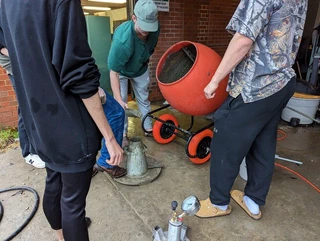
Concrete materials are estimated, sourced, and procured each term from Century Ready Mix (Ruston, LA). Students participate in mix design, batching, casting, curing, and breaking cylinders on a professional load frame.
Student Learning Outcomes
Students completing CVEN 3023 will be able to:
- Apply principles of engineering, science, and mathematics to describe and characterize construction materials used in engineering practice
- Perform fundamental laboratory tests — tensile, flexural, and compression — and apply results to engineering design
- Understand cement and fly-ash classification per ACI standards
- Communicate effectively through written lab reports and formal in-class presentations
- Recognize the ethical importance and professional responsibility of standardized materials testing
- Function effectively on a laboratory team and foster a collaborative, inclusive environment
- Explain the properties and applications of fly-ash-based geopolymer cementitious materials
