Searle's Apparatus for Halloysite Nanotube Coatings
Thermal regulating paint can cut the energy use of a temperature controlled building by adding an insulating barrier to the walls. The insulating paints on the market are not cost or performance competitive with expanding polyurethane foam, which is what keeps them out of general use. The Advanced Materials Research Lab at Louisiana Tech was working on latex paint doped with halloysite nanotubes to close that gap, and the work needed an instrument that could measure the thermal conductivity of a coating.
Searle’s apparatus is the classic method for measuring the thermal conductivity of a solid rod. It is cheap and simple, which is why it is normally a teaching instrument rather than a lab one. The goal here was not to reinvent it but to modernize it.
Building the instrument
Glass mercury thermometers were replaced with thermocouples feeding a computer logger. The steam jacket became an electric steam generator. Analog balances and timers became digital.
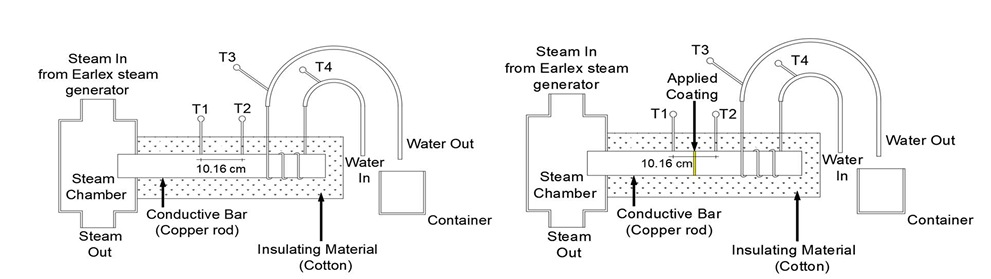
Apparatus layout. The left arrangement measures a solid copper rod as a baseline. The right splits the rod and places the coating at the interface, so the measured drop reflects the coating.
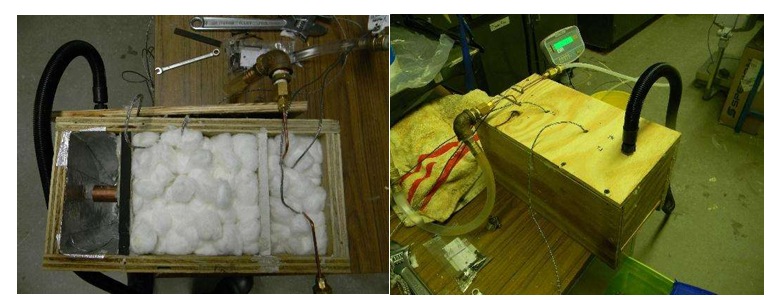
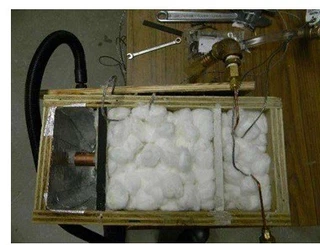
The apparatus open and closed. Cotton batting packs both chambers, and the steam chamber is lined with aluminum tape to reflect heat back in.
The specimen is a 12 in copper bar, 1 in in diameter, cut in half. One half sits on the heated side and one on the chilled side, and the coating under test goes on the interface between them. Measuring the solid rod first gives a baseline to compare against.
The housing is plywood, 3/4 in outside and 1/2 in for the internal supports, with roughly 1 in holes in the internal panels to carry the rods. The steam chamber is lined with aluminum tape to reflect heat back in and cut losses, and copper tubing carries heat from the rod into the chilled water. Both chambers are packed with cotton batting.
Instrumentation and procedure
Four thermocouples run to an eight channel USB logger, with the probes on the rod spaced 10.16 cm apart. A digital balance under the outlet records the mass of chilled water passing through, which is what the conductivity calculation needs.
Steam is held at 100 °C and the chilled water at 13 to 14 °C, with lab ambient between 18 and 22 °C. Each test runs 30 minutes and logs at 5 minute intervals. The apparatus then needs about 24 hours to return to thermal equilibrium before the next run, which is the practical limit on how fast samples can be worked through.
Simulating the instrument
I built five models of the apparatus in SolidWorks and ran transient thermal analysis on each, increasing the complexity step by step to see how much detail the results actually needed. The set covers the solid rod, the split rod with a coating, versions driven by thermal loads and heat flux taken from the first two, and an aluminum cylinder used for heat capacity testing. Copper was modeled at 390 W/m·K and the 3003 aluminum at 170 W/m·K.
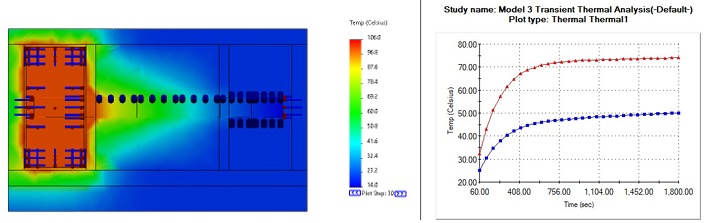
Transient thermal analysis of the apparatus. The contour plot shows heat moving from the steam chamber along the rod, and the temperature plot tracks two probe locations over the run.
Limitations
Specific heat was not determined experimentally and was taken from literature, which is a direct source of error in the transient results. The simulated assembly is also simplified against the real apparatus, since the software could not carry every detail of the build.
Credit
This was carried out at the Louisiana Tech Advanced Materials Research Lab with Hawa Hashm, John Kraft, John Matthews, David Hall, Yuri Lvov, and Shaurav Alam. The coating study the apparatus supported was published in Construction and Building Materials, Vol. 392.
