SpaceX Starship Heat Shield Tile: FESEM/EDS Characterization
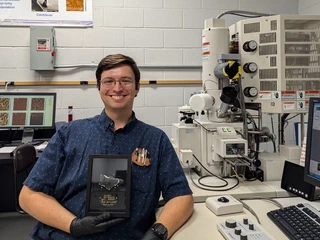
Over the summer I purchased a fragment of a SpaceX Starship heat shield tile from eBay. Based on the listing information it was from Integrated Flight Test 1 (IFT-1, April 2023), Ship 24 / Booster 7. While working with the Hitachi S-4800 field emission SEM at Louisiana Tech University’s Institute for Micromanufacturing (IfM) I decided to test a piece of the tile. The goal was to characterize the tile’s microstructure and elemental composition using secondary electron imaging and EDS, the same methods I apply routinely to geopolymer and cementitious materials in my dissertation research.
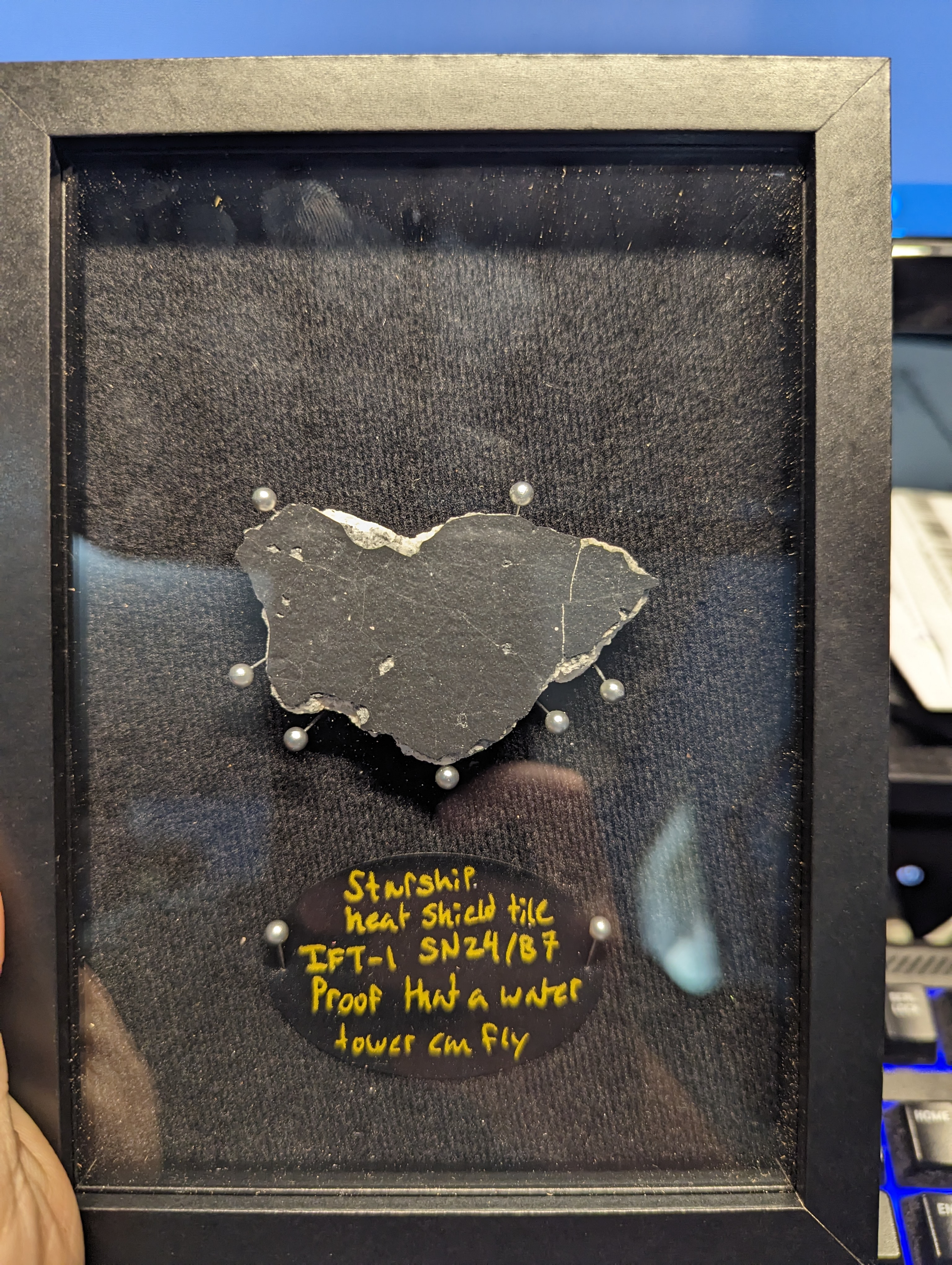
The fragment in its shadow box. The label reads, “Proof that a water tower can fly.”
Specimen
The tile has two distinct layers: a black outer coating over a white fibrous ceramic body. The coating was tougher and more rubbery than I expected. I had assumed it would be a thin, brittle glaze like the reaction-cured glass on the early Space Shuttle tiles, but it was not glassy at all. That matches published teardowns of Starship tiles, which point to a toughened coating in the TUFI family (a molybdenum-disilicide-bearing ceramic) rather than the older borosilicate glass.
At the macro scale the material was delicate and easily crumbled into a fine powder when handled. This made collecting samples for SEM easy in some ways, since I could scrape powder straight onto the carbon tape. I prepared and imaged two separate regions: a fragment of the black coating, and a piece of the white fiber substrate. Each was mounted on a 15 mm aluminum SEM stage with conductive carbon tape.
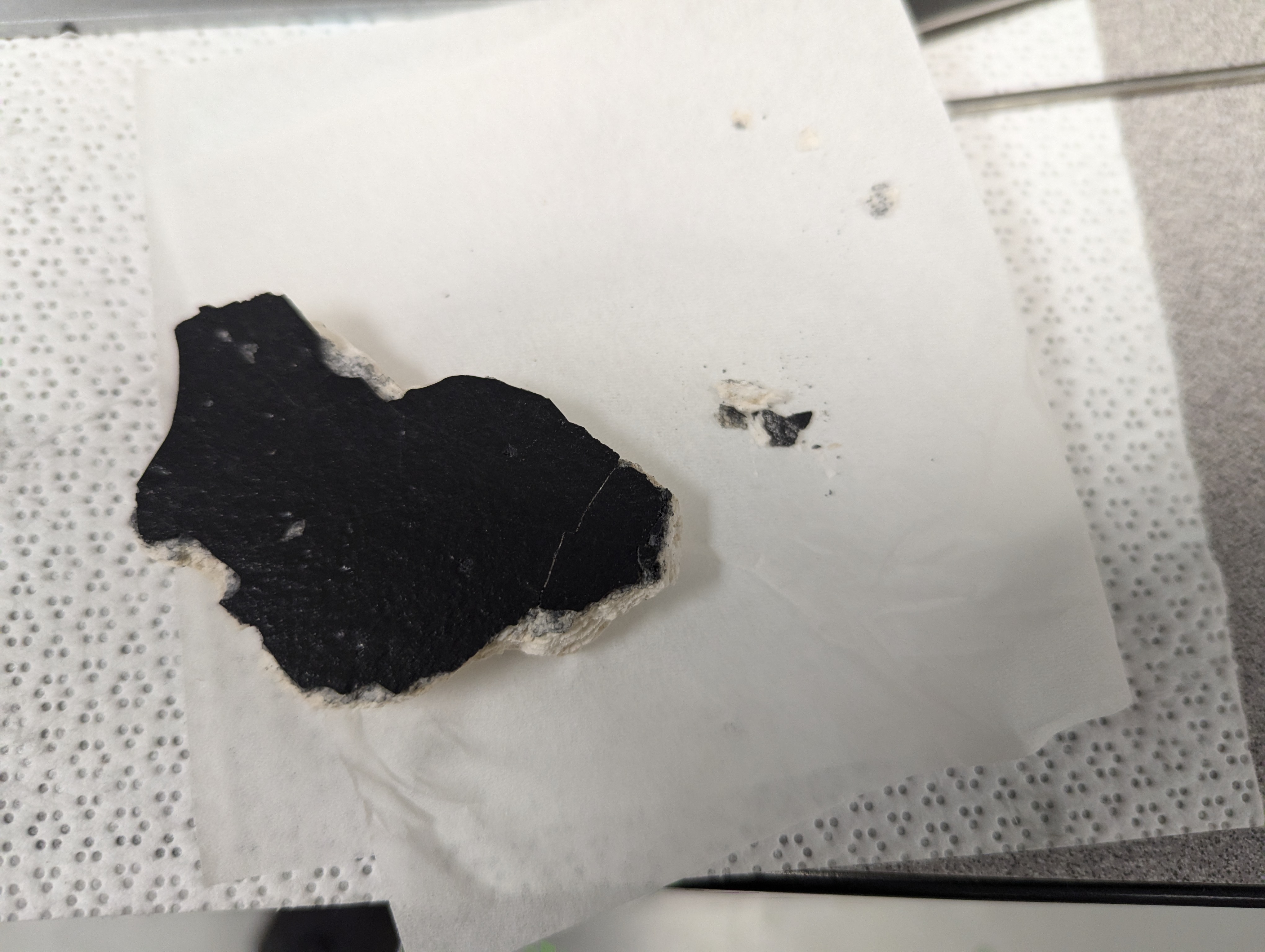
The tile fragment. The black outer coating sits on top of the white fibrous body, visible along the broken edge.
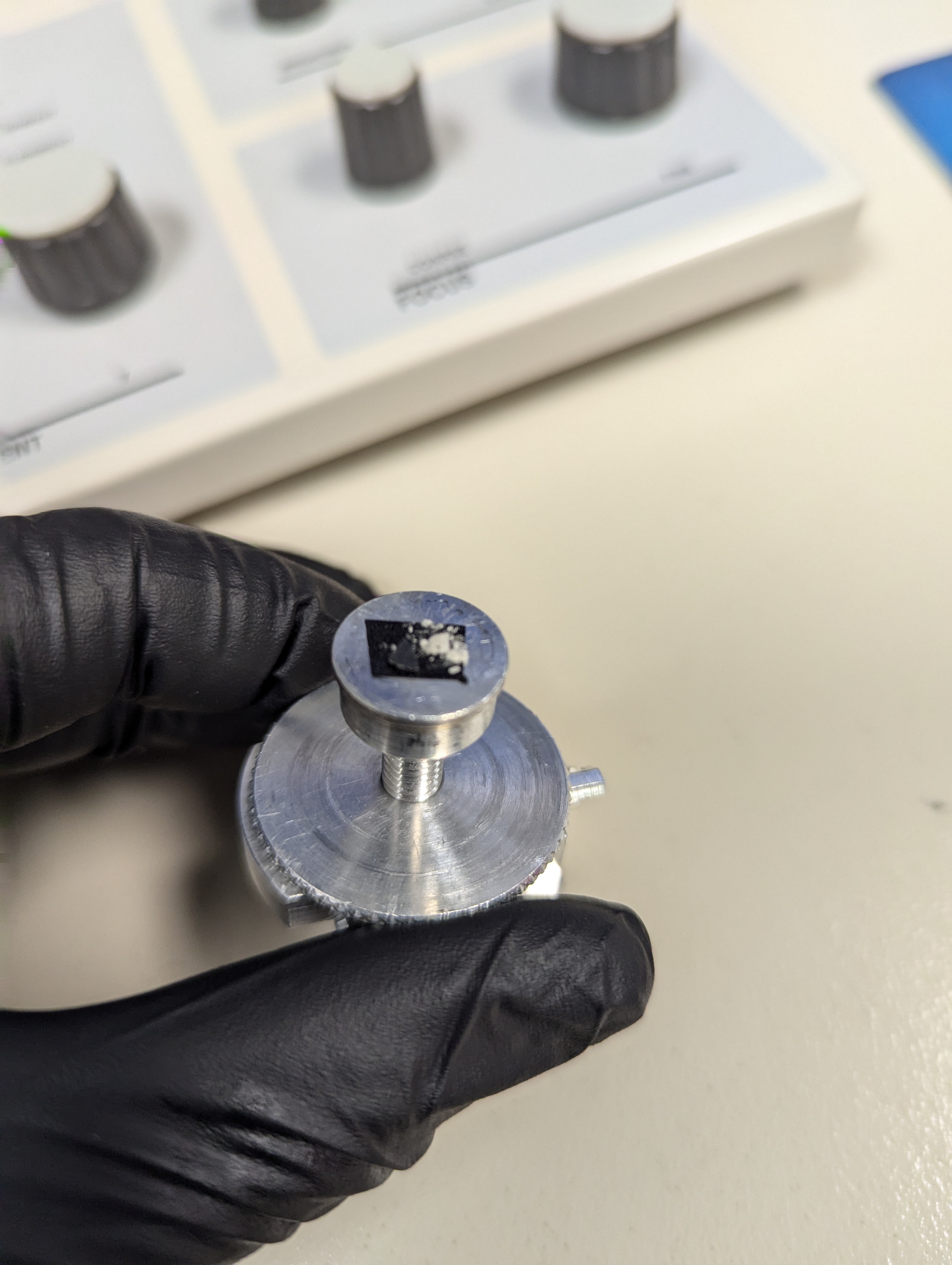
A coating sample on the 15 mm aluminum SEM stage, mounted with carbon tape and ready for the chamber.
Imaging and EDS Settings
Everything was done on the Hitachi S-4800. I ran the secondary electron imaging at 3 kV to keep surface charging down and preserve fine surface detail, then switched to 20 kV for EDS so the beam would penetrate deep enough for reliable elemental readings. Working distance stayed around 10 mm, and magnification ranged from 30x to 8,000x.
Microstructure
Black coating
At low magnification the coating fragment is mostly smooth, with a few bits of loose debris on it. As you zoom in it turns out to be more uneven than it first looks, with a rippled, bumpy surface rather than any sharp edges or folds. Under the 20 kV EDS beam it lit up with a strong charging bloom, which fits a poorly conductive, dielectric coating rather than a conductive ceramic.
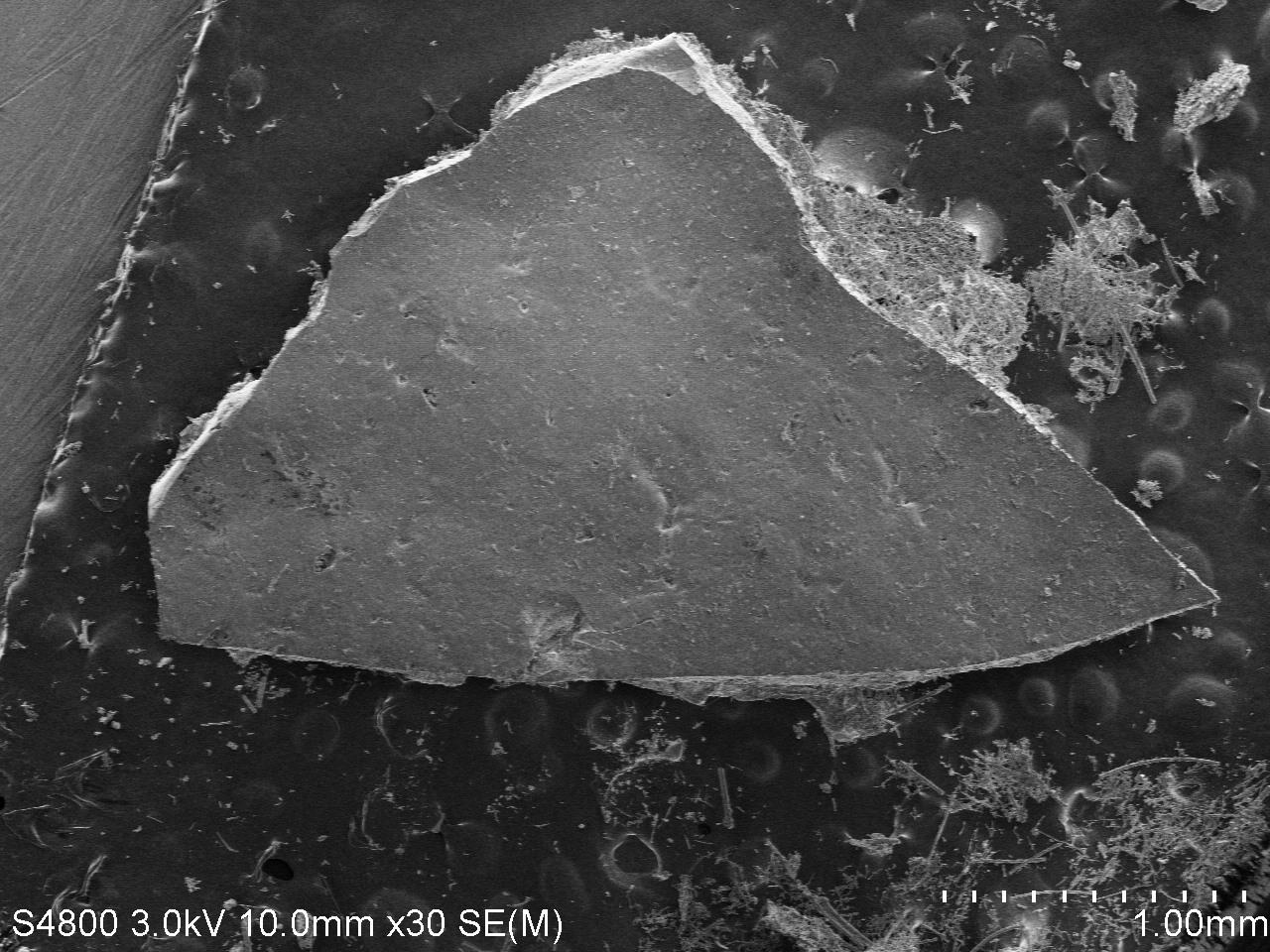
Black coating at 30x (1 mm scale bar).
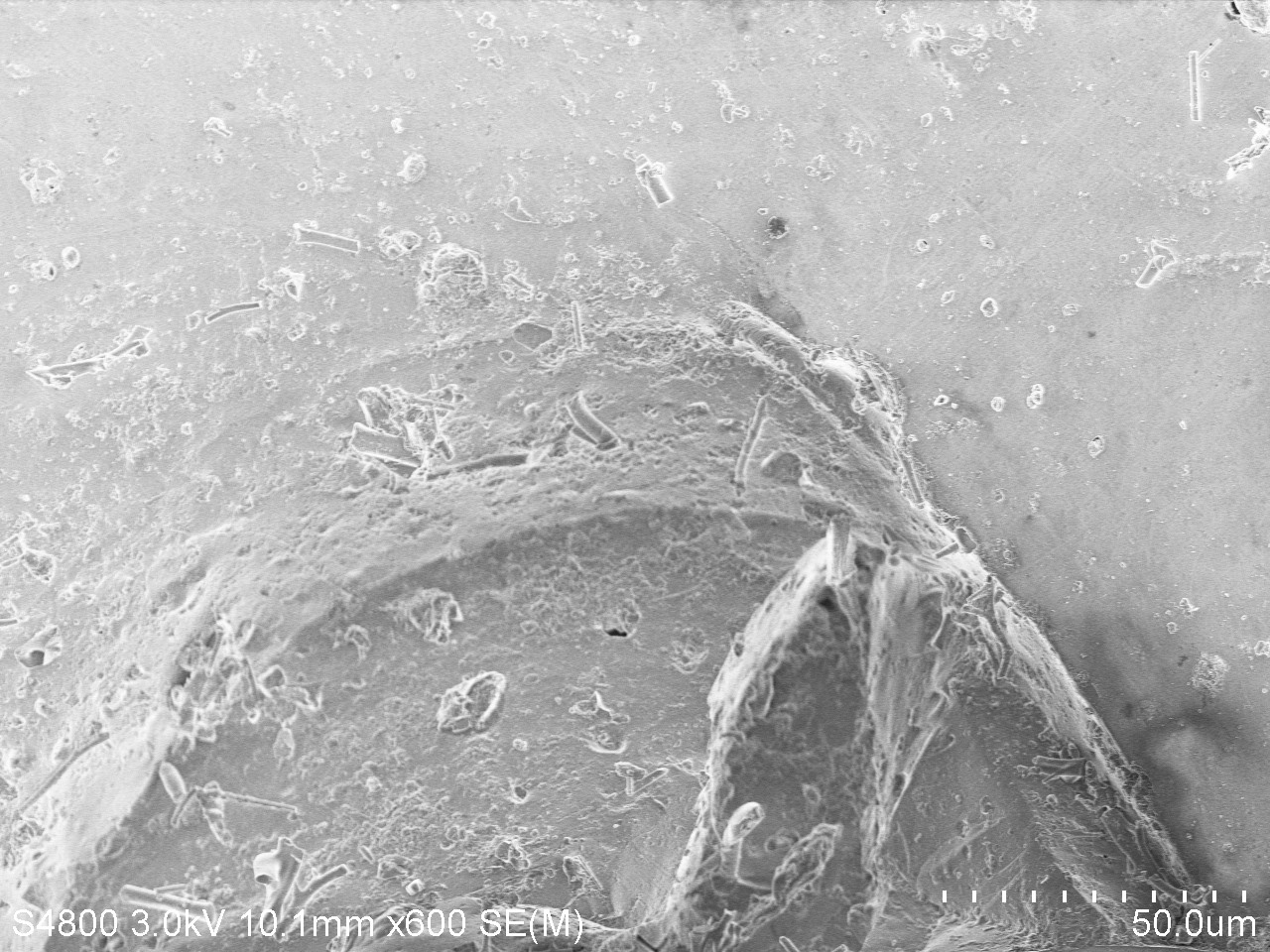
Coating surface at 600x (50 μm scale bar). Mostly smooth with a rippled, bumpy texture and some scattered debris.
Fiber substrate
The white substrate is a loose, tangled mass of fibers with a lot of open space between them. That low-density, open structure is what makes the tile such a good insulator. The fibers cover a wide range of sizes: the largest run around 55 to 60 μm across, with plenty of smaller ones down to 15 μm or less mixed in. At higher magnification they resolve into smooth cylindrical rods.
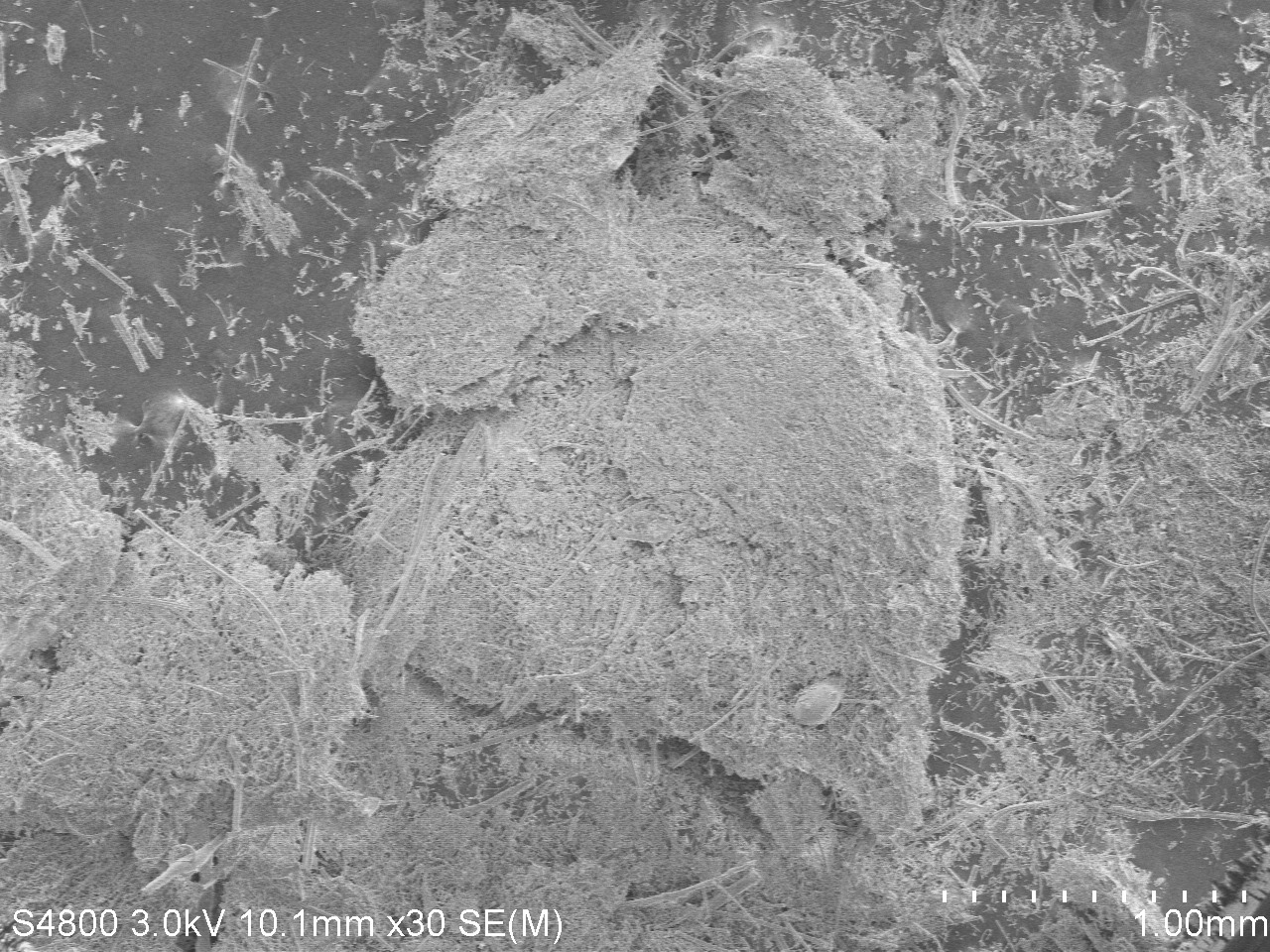
Fiber substrate at 30x (1 mm scale bar). A compressed, felt-like mass of fibers.
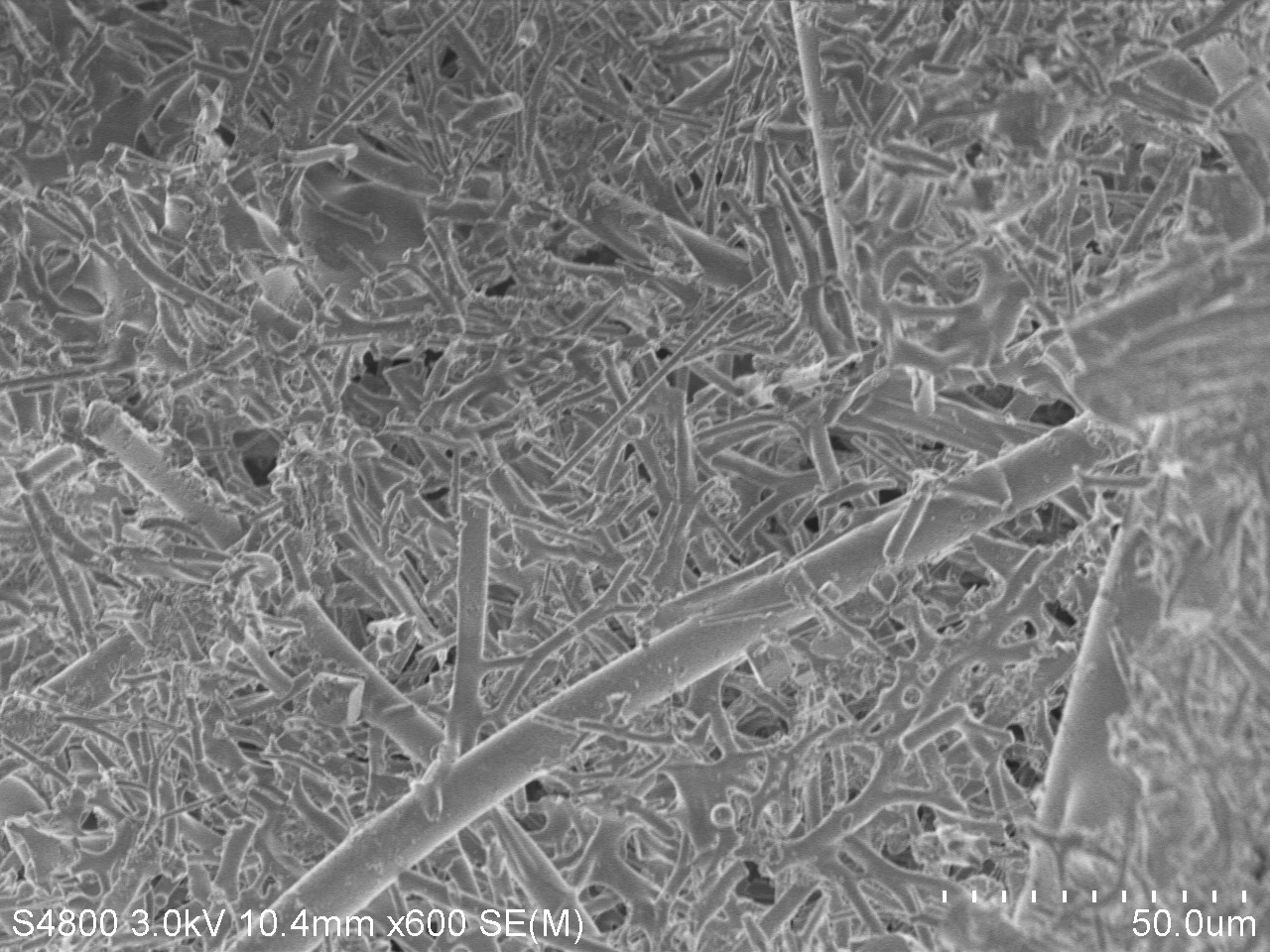
Fiber network at 600x (50 μm scale bar). Random orientation with large open voids.
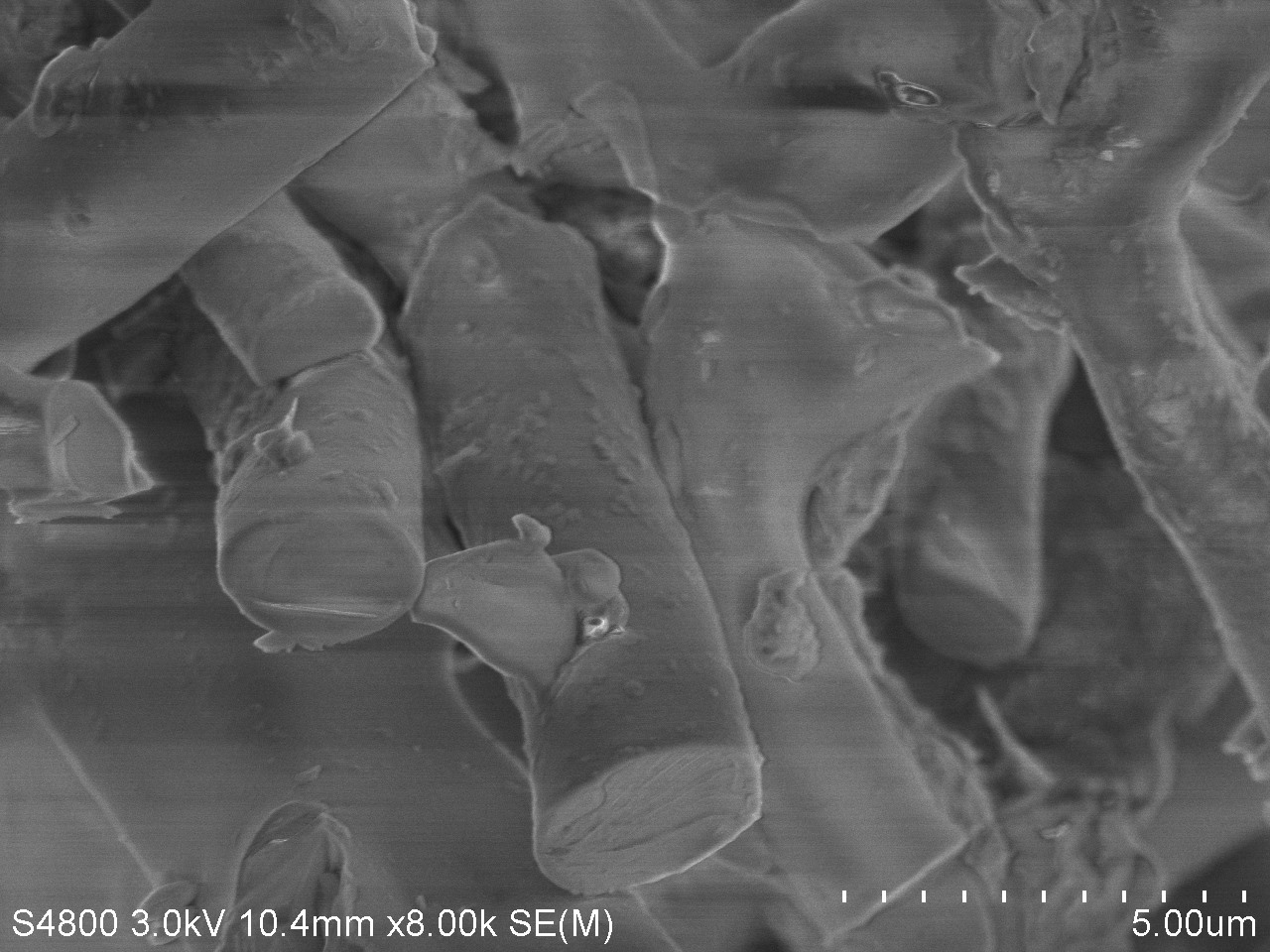
Individual fibers at 8,000x (5 μm scale bar). Smooth cylindrical rods, here the smaller fibers around 15 μm and under.
Elemental Composition (EDS)
I ran EDS at 20 kV on both regions. Oxygen and silicon dominate in both, which is what you would expect from a silica-based system. The two regions split mainly on carbon and the minor elements.
| Element | Fiber substrate (mass norm. %) | Coating (mass norm. %) |
|---|---|---|
| Oxygen | 50.1 | 51.2 |
| Silicon | 30.5 | 15.1 |
| Carbon | 10.3 | 32.1 |
| Aluminum | 4.0 | 1.1 |
| Chlorine | 2.6 | ~0.1 |
| Sodium | 1.8 | 0.1 |
| Iron | 0.3 | n.d. |
| Sulfur | 0.3 | 0.3 |
| Potassium | 0.1 | n.d. |
The coating came back much higher in carbon than the fiber body. The coating is the outer layer, so I expected some carbon, but the fragment I mounted was thin and sitting right on carbon tape, and I suspect a lot of that signal is really the tape showing through. I would not read the coating’s carbon number as much more than an upper bound. The fiber substrate carries a few percent aluminum, which points to an alumina-enhanced silica fiber (AETB-type) rather than pure silica.
The sodium and chlorine in the fiber substrate showed up together and in similar amounts, which points to sodium chloride, plain sea salt. IFT-1 came down in the Gulf of Mexico off Boca Chica, so the tile most likely picked up the salt from the water before it ever reached me.
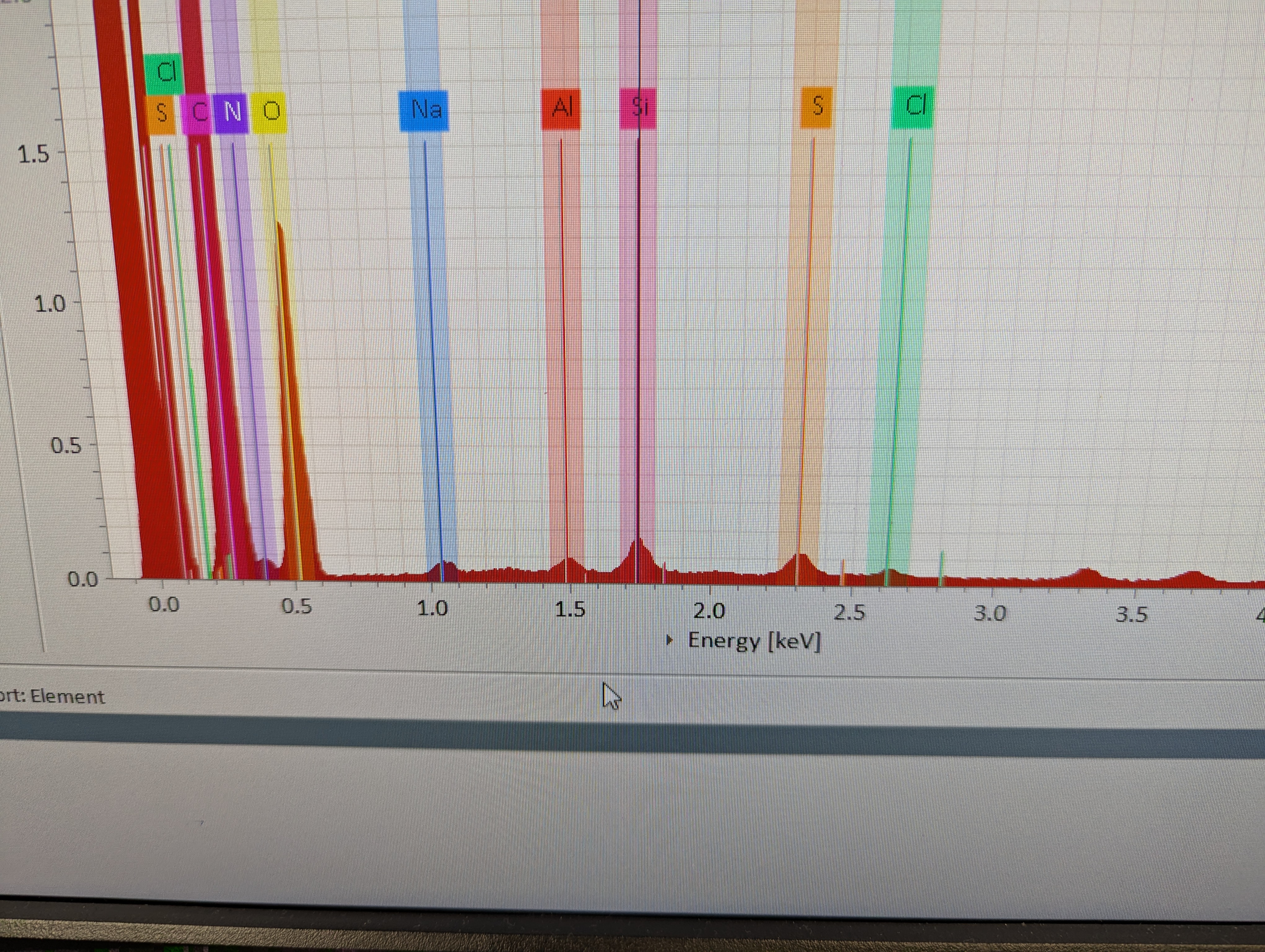
EDS spectrum from the fiber substrate. The two large peaks are silicon (about 1.74 keV) and oxygen (about 0.52 keV), with smaller sodium and aluminum.
Key Findings
- The tile is built in two layers: a tough black outer coating over a low-density white fibrous body, clear at both the macro and microscopic scale.
- The white body is mostly silica, about 30% Si and 50% O by mass, with a few percent aluminum. That points to an alumina-enhanced silica fiber (AETB-type) rather than pure silica.
- Its fibers form a loose, random, high-void network, which is what gives the tile its low thermal conductivity. They resolve as smooth cylindrical rods and range widely in size, from roughly 55 to 60 μm across down to 15 μm or less.
- Sodium and chlorine turn up together in the body, most likely sea salt the tile picked up when it came down in the Gulf of Mexico off Boca Chica.
- The black coating runs much higher in carbon and lower in silicon than the body, and it felt tough and rubbery rather than glassy. That matches published teardowns pointing to a TUFI-type coating instead of the brittle reaction-cured glass on early Shuttle tiles.
- The coating charges hard under the 20 kV beam, so it is far less electrically conductive than the fibrous body.
Connection to Research
This was a side project, but it connects my main research on sustainable cementitious materials to aerospace thermal protection. Both come down to silica-based ceramics, multi-phase compositions, and EDS as the compositional probe, and I characterized the tile on the same S-4800 and EDS workflow I use for fly-ash geopolymers. It was a good way to get more comfortable with high-temperature fibrous ceramics and to confirm that the characterization skills I have built carry directly over to aerospace materials.
