High-Altitude Balloon Telemetry with APRS

A high-altitude balloon goes up until the envelope bursts, then the payload comes down somewhere downrange. If you want the payload back, and the data on it, you need to know where it is the whole way. Cell coverage does not help at altitude and does not help in the places these things land. Amateur radio does.
I tracked weather balloon payloads with the Louisiana Tech Aerospace Club and was on the chase and recovery team. I later gave a technical talk on APRS to the university amateur radio club, W5HGT. My callsign is KG5RLJ.

Aerospace Club launch, January 2017. Balloon with insulated payload including ham radio transmitter and Raspberry Pi GPS, in flight.
What APRS is
APRS is the Automatic Packet Reporting System, a digital mode for sending short packets of data over amateur radio. It carries GPS position, weather data, text messages, and station identification.
Underneath it is packet radio running the AX.25 protocol, the amateur adaptation of X.25, which was written in the 1980s for telecom carriers and financial transactions. Data moves at 1200 or 9600 baud using Bell 202 tones, with the bits encoded as audio frequency shift keying. The ones and zeros are sent as two audio tones over a voice radio.
Getting a packet home
APRS runs on 144.390 MHz in the 2 meter band. That is line of sight, and a transmitter on a balloon has line of sight to a very large area, which is what makes balloons work well on it.
The transmit chain is a GPS receiver for position, a terminal node controller to build and format the packet, and a VHF radio to send it. On the ground the packet is picked up by another radio, by a digipeater, or by satellite. Digipeaters retransmit what they hear at higher power, which extends range past line of sight, and many of them also push what they receive to internet mapping services such as aprs.fi. A packet sent from a balloon can end up plotted on a public map without the sender running any ground infrastructure.
How far a packet gets repeated is set by its path, written as WIDEn-N. The first number is how many hops are requested and the second counts down by one at each retransmission. When it reaches zero the packet stops being repeated. It is a hop limit, and it keeps the network from drowning in echoes of itself.
Hardware
There is a cheap way to do almost every part of this.
For decoding, a software modem does the job. Direwolf and AGWPE are both free and run on Linux or Windows. A dedicated terminal node controller such as the MFJ TNC-X runs about 75 USD, and what that buys is hardware that works without a computer attached and is not limited to APRS.
For receiving, an RTL-SDR card costs 25 to 30 USD and covers 500 kHz to 1.7 GHz. It is receive only, so it cannot send, but it will pull in packets and can be driven from SDR# or programmed in MATLAB.
For transmitting, a handheld radio paired with a phone works. A Baofeng UV-5R running APRSdroid will send and receive.
The receiving setup I recommended in the talk was an SDR card into SDR#, audio piped through VB-Cable into Direwolf to decode the packets, and SARTrack to plot them. Everything in that chain except the card is free.
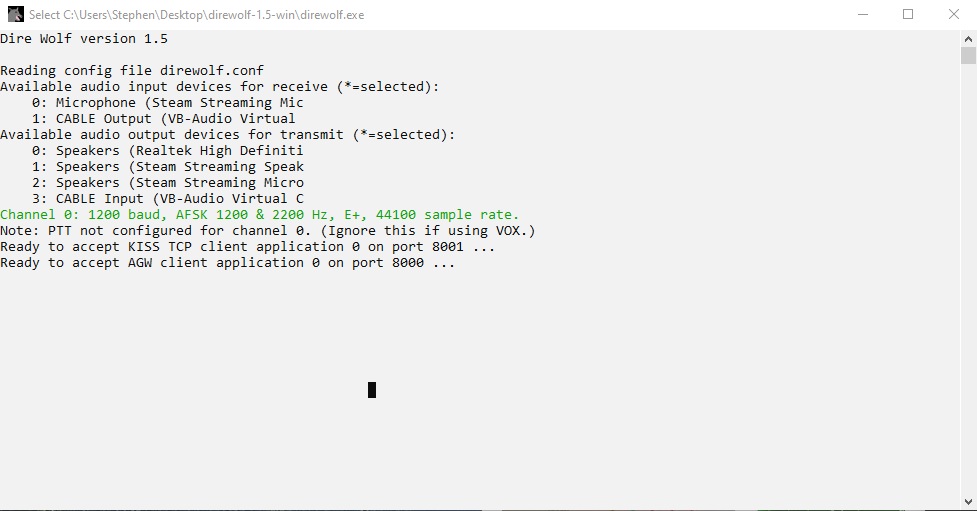
Direwolf decoding 1200 baud AFSK at 1200 and 2200 Hz during a local test, with audio arriving over VB-Cable.
Why it suits a balloon
A payload under a balloon is a transmitter with an unobstructed view over a wide area, which is the condition APRS works best under. It reports position on a public network with no subscription and no ground infrastructure to stand up first.
